
China’s April Economic Slowdown: How Trade War Tensions Are Fueling Market Uncertainty
Ad Code Here
China’s April Slowdown Reflects Economic Uncertainty Amid Trade War Jitters
Key Takeaways: China’s economic activity in April showed signs of moderation as trade war uncertainty weighed on confidence. While manufacturing proved more resilient than expected, retail sales, fixed-asset investment, and property prices all softened, reflecting heightened caution among consumers and businesses.
1. Property Market Softens Further as Recovery Remains Elusive
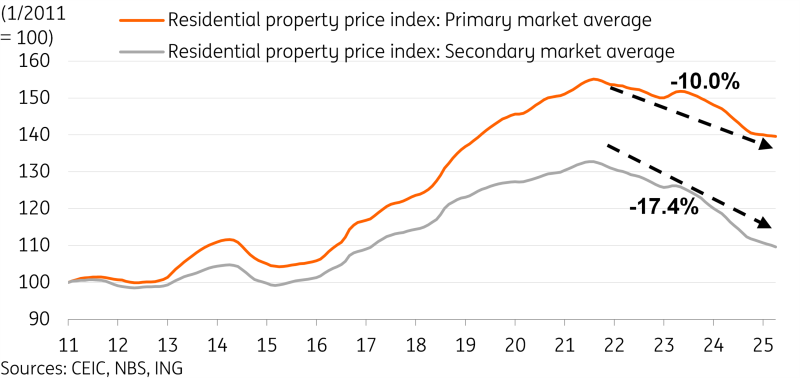
The residential property market continued its downward trend in April, with new home prices declining -0.12% MoM and existing home prices falling -0.41% MoM—both at a slightly steeper pace than in March.
Primary Market
- Only 25 of 70 cities saw stable or rising new home prices, down from 28 in March.
Secondary Market
- Just 6 of 70 cities reported stable or higher existing home prices, a sharp drop from 14 in March.
The secondary market’s underperformance is particularly concerning, as it directly impacts household wealth and confidence. While the 10bp rate cut in May may provide marginal relief, a broader recovery hinges on stabilizing prices and reducing inventory overhang.
Source: CEIC, NBS, ING
2. Retail Sales Growth Slows, But Trade-In Policy Boosts Select Sectors
In April, retail sales growth slowed to 5.1% YoY (down from 5.9% in March), with significant differences observed across categories:
Strong Performers
- Household appliances (+38.8% YoY)
- Communication appliances (+19.9% YoY)
- Gold & jewellery (+25.3% YoY)
- Furniture (+26.9% YoY)
(Likely driven by trade-in policies and housing market stabilization in some cities.)
Weak Spots
- Auto sales (+0.7% YoY)
- Petroleum (-5.7% YoY)
- Apparel (+2.2% YoY)
While the trade-in policy has clearly stimulated demand in targeted sectors, broader consumption remains uneven, suggesting that consumer sentiment—tied to wage growth and asset prices—needs further improvement.

Source: CEIC, ING
3. Industrial Production Holds Up Better Than Expected
Despite tariff fears, industrial production increased 6.1% YoY (down from 7.7% in Q1) and manufacturing expanded 6.6% YoY in April.
- Textiles slowed sharply (2.9% YoY vs. 6.5% in Q1), reflecting tariff impacts on easily substitutable goods.
- Other manufacturing sectors proved more resilient, as many lack readily available alternatives outside China.
The tariff ceasefire could lead to a short-term rebound in orders as importers stockpile goods in case of future hikes. However, prolonged trade tensions may eventually push some production offshore—though not immediately, given global uncertainty.

Source: CEIC, ING
4. Fixed Asset Investment Growth Slows Amid Caution
Fixed-asset investment (FAI) growth softened to 4.0% YoY (ytd), with both public (6.2%) and private (0.2%) sectors pulling back.
- Manufacturing FAI remained strong at 8.8% YoY (ytd), supported by equipment renewal policies.
- Real estate investment (-10.3% YoY ytd) continued to drag, requiring further price stabilization before recovery.
The May rate cut may provide some support, but private sector confidence remains the key driver.
Outlook: Caution Prevails, But Manufacturing Resilience Offers Hope
April’s data highlights how trade war uncertainty is dampening sentiment, slowing consumption and investment. But manufacturing has fared better than anticipated, indicating that:
- Tariffs impact some sectors more than others (e.g., textiles vs. high-tech manufacturing).
- A protracted ceasefire might promote restocking and calm attitudes.
- Property market recovery remains gradual, requiring further policy support.
We maintain our 2025 GDP forecast at 4.7% YoY, with risks balanced for now. The key watchpoints ahead are:
- ✅ Progress in U.S.-China trade talks
- ✅ Further property market stabilization measures
- ✅ Household confidence recovery
For now, caution prevails, but clarity on trade could help lift the economic outlook in the coming months.

Sources: CEIC, NBS, ING, Shutterstock


0 Response to "China’s April Economic Slowdown: How Trade War Tensions Are Fueling Market Uncertainty"
Post a Comment